

Assess · Understand the problem
Experimentation & Mission Assessment
Rapid experimentation and independent assessment that test, evaluate, analyze, and inform the decisions behind new technology.
Turn ideas into evidence
Overview
At Indigo Industries, we recognize the critical importance of thorough testing and evaluation (T&E) in delivering effective, reliable, and innovative solutions to the modern warfighter. Our services rigorously assess the performance, durability, and usability of defense technologies, from developmental and operational testing to joint evaluations and live fire validation, under realistic operational conditions and in compliance with OSW/R&E standards.
We employ an integrated framework that combines real-world scenario testing with advanced analytics and simulation tools such as MATLAB, Simulink, ANSYS, and STK. A rapid prototyping feedback loop allows for quick iterations based on real-time data, significantly reducing development timelines while enhancing the functionality of the final product.
Capabilities
What we do
Rapid experimentationFast, mission-relevant experiments that show what a technology can do before anyone commits to buying it.
What it means
Rapid experimentation puts a prototype in front of real users, in realistic scenarios, in weeks rather than years. Instead of one long test that assumes the requirements and interfaces will stay still, it runs short cycles: try it, learn what works and what breaks, adjust, and try again.
What we do
Indigo plans and runs experiments built around the operational question a sponsor needs answered. We design mission-relevant, intentionally stressing scenarios, run them alongside warfighters and other systems, and capture what happens. Structured events such as T-REX are a natural venue, because they expose interoperability and human-factors issues that never show up in an isolated demonstration.
Every cycle feeds the next. Findings go back to the developer and the sponsor quickly, so a technology can improve between iterations instead of waiting for a final report.
- Experiments designed around the sponsor's decision
- Mission-relevant, stressing scenarios
- Execution alongside operators and other systems
- Fast feedback between iterations
- Support for Middle Tier of Acquisition rapid prototyping and rapid fielding
Independent assessmentsUnbiased, third-party evaluation of what a technology actually does, under what conditions, and at what cost.
What it means
An independent assessment is an evaluation run by an organization with no stake in the outcome. As an Independent Test Organization, Indigo separates capability from claim: what a system does, the conditions it does it under, what it costs in operator workload and integration effort, and what must be true for it to succeed in the field.
What we do
For government sponsors, our non-traditional assessments are time-compressed and operationally anchored. They don't replace statutory test and evaluation. They fill the gap between vendor demonstrations and program commitments, and end in a clear recommendation to transition, iterate, or stop.
For industry, an independent assessment gives a company an honest view of how its technology performs under realistic conditions, so its claims are backed by evidence before it reaches a government customer.
- Assessment Reports and Event Observation Reports
- Leadership "baseball cards" on readiness, utility, integration, and recommendations
- Technology Readiness Level (TRL) assessments
- Operational and Military Utility Assessments (OUA / MUA)
Concept development & analysisTurning an operational need into concepts that can be tested: the mission tasks, the employment ideas, and the questions that matter.
What it means
Concept development is the work done before a test: defining the problem, the user, and how a new capability might be employed. Analysis checks those concepts against the mission, so experimentation spends its time on the questions that will actually drive a decision.
What we do
Indigo works with the sponsor, the technology developer, and the intended user from the start. Together we consolidate what is already known about the technology, draft the critical issues, build a candidate list of mission-critical tasks, and identify the user community: the operators, planners, and decision makers who will judge it.
We use modeling, simulation, and analysis to identify capability gaps and urgent operational needs, then shape candidate employment concepts that experimentation can confirm or reject.
- Critical issues and mission-critical tasks
- Candidate employment concepts
- Capability gap analysis with modeling and simulation
- Identification of the key user community
- Integrated teams and working groups
Rapid TTP, CONEMP & CONOP developmentWriting down how a new capability will actually be used, fast enough to test it and improve it in the field.
What it means
Tactics, techniques, and procedures (TTPs) describe how operators employ a system, step by step. A concept of employment (CONEMP) describes how a capability is meant to be used in a mission, and a concept of operations (CONOP) describes how an operation will be carried out with it. Without them, a new technology is just equipment.
What we do
Indigo develops these documents alongside experimentation rather than after it. We draft initial TTPs and employment concepts from the mission analysis, run them in realistic scenarios with the people who will use the system, and refine them from what we observe.
The result is a set of procedures that has already been exercised, so a unit receiving the capability starts with something proven rather than a blank page.
- Draft TTPs, CONEMPs, and CONOPs from mission analysis
- Validation in realistic scenarios with operators
- Revisions based on observed results
- Procedures ready for training and fielding
Threat and operational analysisUnderstanding the threat and the operating environment, so technologies are judged against the conditions they will actually face.
What it means
Threat analysis looks at what an adversary can do: the systems, tactics, and effects a capability must survive or defeat. Operational analysis looks at the mission itself: the environment, the constraints, and what success means. Together they define the conditions a technology has to perform under.
What we do
Indigo builds that picture before a test is designed. We look at contested conditions, such as degraded communications, denied navigation, and electromagnetic interference, and at constrained operating envelopes such as airspace, safety, logistics, and training. Those findings shape the scenarios we run, so results reflect the fight rather than the lab.
After execution, the same analysis frames the results: how a capability performed against the threat, where it falls short, and what that means for the mission.
- Threat-informed scenario design
- Contested conditions: communications, navigation, and electromagnetic
- Operational constraints and success criteria
- Mission-impact analysis of results
Test planning and data collectionDisciplined plans and clean data, so every result can be traced back to what was tested and how.
What it means
Test planning decides what will be measured, under what conditions, and what success means in operational terms. Data collection captures it: configuration, logs, timing, network performance, and operator actions. Without both, a test produces opinions instead of evidence.
What we do
Indigo follows a six-phase methodology, from discovery through reporting results. The plan sets the measures, the conditions to exercise, and the limitations accepted for the sake of learning. Before execution we lock down configuration control, including software versions, waveforms, and payload configurations, and set up the data collection methods.
We also handle the practical work that makes testing possible: range access, airspace coordination, waivers, safety and compliance requirements, and on-site logistics, so participants can focus on the test itself.
- Assessment plans with operational measures of success
- Configuration control
- Instrumentation and data collection
- Range access, airspace coordination, and waiver support
- Technical writing and documentation
Emerging technology assessment & transitionJudging whether an emerging technology is ready, and building the path that moves it into the hands of the warfighter.
What it means
Emerging technology assessment asks whether a new technology is mature enough, useful enough, and supportable enough for the mission. Transition is the step that follows: moving a proven capability from experimentation into a program, a pilot fielding, or a unit's hands.
What we do
Every Indigo assessment ends in one of three clear outcomes: suitable for near-term transition, promising but needing targeted risk reduction, or not competitive for the mission at this time. That clarity lets sponsors put limited time and funding where it counts.
When a capability is viable, we provide a transition-ready picture: known limitations, recommended uses, and an implementation path. Our RF-X and MIDAS frameworks tie evaluation, demonstration, and transition planning into one workflow, so moving forward doesn't mean starting over.
- Technology Readiness Level (TRL) assessment
- Integration and sustainment risks identified early
- Clear recommendations to transition, iterate, or stop
- Transition planning with RF-X and MIDAS
Independent Test Organization
Non-traditional assessments
Non-traditional assessments are time-compressed, operationally anchored evaluations. They determine whether a technology provides measurable mission value, whether it can integrate into an operational system, and what risks must be retired before broader adoption.
"Non-traditional" refers to the approach, not a lower standard of rigor. These assessments don't replace statutory test and evaluation. They fill the gap between vendor demonstrations and program-level commitments with transparent evidence, clear limitations, and actionable recommendations.
Every assessment ends in a clear decision
- Suitable for near-term transition
- Promising, but needs targeted risk reduction
- Not competitive for the mission at this time
Six-phase test and assessment methodology
- 01Discovery
- 02Strategies & objectives
- 03Planning guidance
- 04Planning
- 05Execution
- 06Reporting results
What sponsors receive
- Assessment Reports and Event Observation Reports
- Leadership "baseball cards" summarizing readiness, utility, integration, and recommendations
- Technology Readiness Level (TRL) assessments
- Operational and Military Utility Assessments (OUA / MUA)
- Range access, airspace coordination, and waiver support
Prior performance
Indigo has tested and evaluated a wide variety of technologies utilized in exercises around the world.
- Stratospheric Balloon Systems

- High Altitude Long Endurance (HALE) UAV

- Renewable Energy Sources

- Persistent Surveillance Systems

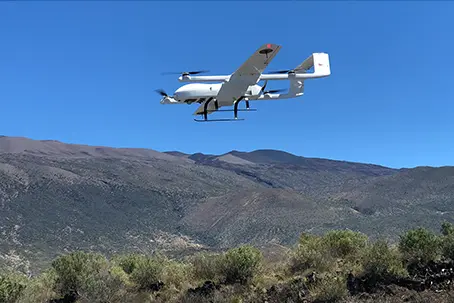
- Unmanned Systems
- Industrial Control Systems (ICS)

Ready to transform your operational capabilities?
Whether you're looking to upgrade systems with the latest technologies or need rapid development and deployment of a new solution, Indigo Industries is your premier partner.
We're hiring
Join us in transforming defense strategies and operations.